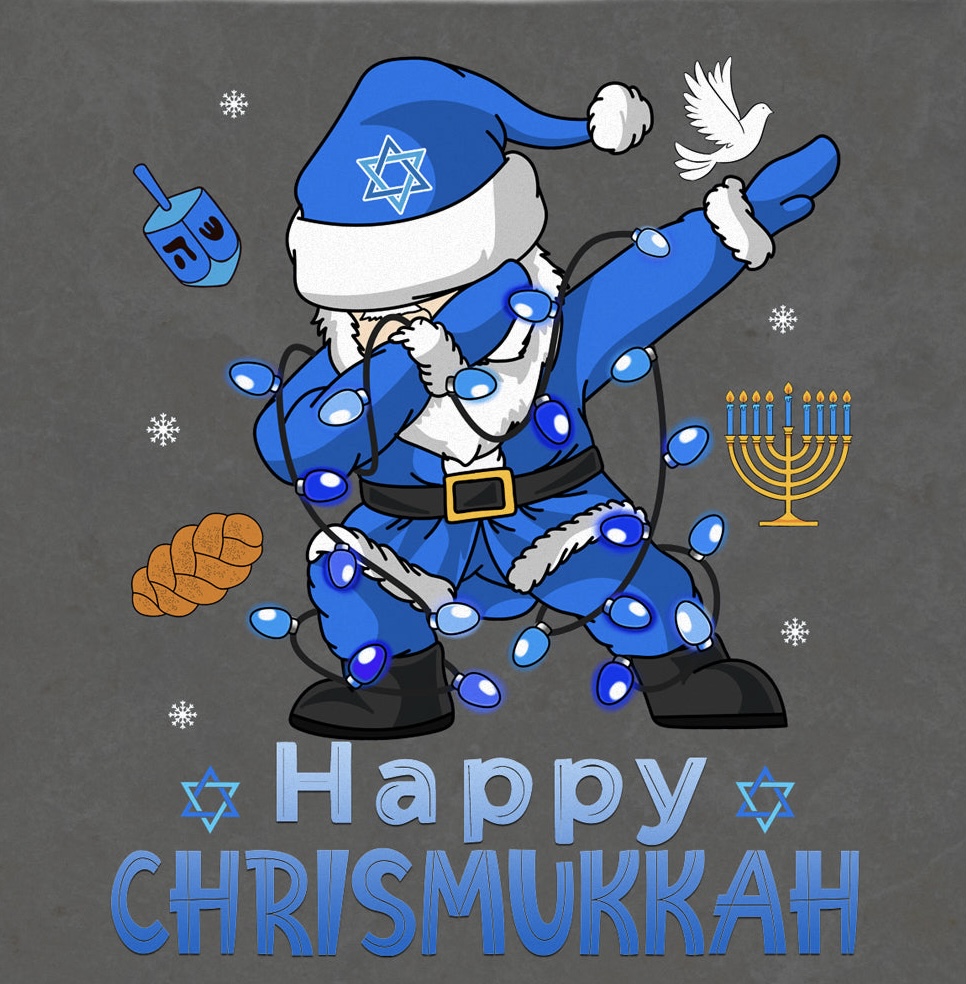
Happy Chrismukkah! This holiday pop culture reference from Naughties television show The O.C. is a combination of Hanukkah and Christmas. But where does Chrismukkah come from? There are two origins of Chrismukkah, the original invention of the term and when it first found its way into the pop culture vernacular.
Most people think that Chrismukkah is something new and irreverent brought to us at the turn of the last century by those cheeky wack millennial kids. According to the Jewish Museum Berlin, Chrismukkah was first observed in the 19th century by German Jews in Germany. The term for this new holiday was the German word Weihnukkah, a combination of the word Weihnachten, Christmas in German, and Hanukkah.
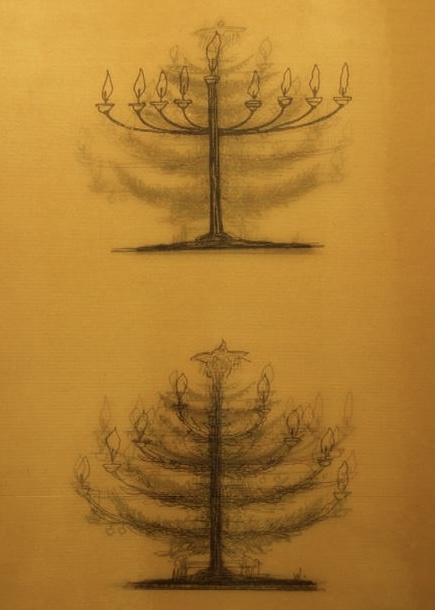
While German Jews are credited for creating the holiday, no single person is credited with inventing it. Sadly, not much has survived from it either. Mostly all that remains is a 1904 postcard preserved at the Jewish Museum Berlin. The postcard combines an image of a menorah with a Christmas tree.
The caption on the postcard reads:
“Darwinian: Zionist caricature on assimilation, from the periodical, ‘Schlemiel’ (1904)”
Ultimately Weihnukkah never had much of a following and just about disappeared after Hitler came to power in Nazi Germany.
Twenty years ago a 2005 exhibition at the Jewish Museum Berlin demonstrated that the concept of Chrismukkah goes back over a hundred years to a time when assimilated German Jews appropriated Christmas celebrations as their own in a secular fashion. This eagerness to assimilate by a segment of the population led to a decline in the number of Jews in Germany. Interfaith marriages rose from 15 percent at the turn of the century to 44 percent at the time the Nazis seized power in 1933. Studies indicate that only a quarter of children from mixed marriages were raised as Jews at this time. At the beginning of the 20th century approximately 1,000 German Jews converted to Christianity every year in part an attempt to escape religious persecution. This phenomena resulted in the rate of Jews leaving the community exceeding that of its natural increase.
Ironically, of course, it was the assimilated and converted Jews who were most shocked when the Nazis came to power and told them that they no longer counted as German.
Cut to 2003 when along comes television show The O. C. Seth Cohen, one of the shows principal characters, comes from a multi-faith Jewish and Christian background. Instead of choosing to celebrate both holidays or one of the holidays, young Seth decides to combine Christmas and Hanukkah for Chrismukkah, now rebooted through the force of pop culture. Despite Cohen’s claim, he did not in fact invent the holiday.
Throughout its four year run The O.C. aired numerous Chrismukkah episodes which often depicted key Chrismukkah traditions that Seth found extremely important. These included a yarmulke fashioned to match Santa Claus’s suit which Seth called a yarmaclaus and the need for a menorah to be featured prominently over the Christmas stockings.
Chrismukkah does not stop with the silver screen. Like with all holidays, Chrismukkah has become commercialized. If you search Chrismukkah on Etsy, there are easily over 500 different products represented, impressive for a 100 year old holiday only recently re-introduced by a modern prime time teenage soap opera. For die hard celebrants (pun intended – the editor) there is also the comprehensive book Chrismukkah: Everything You Need to Know About Celebrating the Hybrid Holiday.
Today there doesn’t appear to be much evidence that people celebrate Chrismukkah as anything more than a pop culture reference. Many who grew up celebrating Christmas and Hanukkah in multi-faith households have celebrated some version of Chrismukkah, albeit unknowingly, for generations. Incorporating traditions from both holidays; it is not usual to see a menorah on a ledge next to the Christmas tree.
So, with that in mind and the holidays now upon us, enjoy your Chrismukkah! Or Hanukkah. Or Christmas. Or Kwanza. Or Solstice. Or Festivus. Or Non Denominational Holiday Tree. Or whatever. Whatever you practice, enjoy joy! Celebrate love, kindness and be happy. Or whatever.