

Hart Island, New York
The unhoused and the unloved. The unknown and the unwanted.
Everything and everyone polite society wanted to be kept hidden and swept under the rug got unceremoniously shipped off to the lonely isolation of New York’s Hart Island.
Alcoholics, drug addicts, psych patients, debtors, reform school kids, the homeless, the quarantined, criminals, prisoners, inmates, derelicts, delinquents young and old, victims of disease feared for their presumed contagions, and the dead. Over a million unclaimed and unwanted. This is their story.
Hart Island is located at the western end of Long Island Sound in the Bronx, New York City, a significant and somber site with a rich yet haunting history.

The potter’s field burial ground located on New York’s Hart Island has been described as the largest tax funded cemetery in the United States, the largest such in the world, and one of the largest mass graves in the United States.
Measuring just 1 mile long and 0.33 miles wide, its multifaceted narrative includes roles as a Civil War training ground, a Union prison camp, a psychiatric institution, an unsavoury final destination for both drug addicts and alcoholics alike and, perhaps most notably, as a potter’s field burial site for the city’s unwanted and unclaimed dead.

According to noted American author and historian Elliott Gorn, long before its public use, Hart Island was the unofficial central hub for unsanctioned bouts of bare-knuckle boxing in the early 19th century, often drawing thousands of spectators in that time. This perhaps may have been the first and final cause for any kind of celebration on the island.
The first public use of Hart Island was in 1864 during the Civil War when the island was used as a training ground for the 31st Infantry Regiment of the United States Colored Troops. Apparently the United States Army thought it prudent to keep the sight of armed African American soldiers in training away from the prying eyes of a fearful and racist civilian base. A steamboat shuttled recruits to the island from the Battery at the southern tip of the island of Manhattan.
A commander’s house and a recruits’ barracks were built. The barracks would eventually include a library as well as a concert room, housing 2,000 to 3,000 recruits at a time. During the American Civil War over 50,000 African American men were trained there.
In November 1864, the construction of a prisoner of war camp began on Hart Island with room for up to 5,000 inmates. The camp was used for four months in 1865 during the American Civil War. In that time the island housed 3,413 captured Confederate Army soldiers from the South.
The first burials on Hart Island were those of twenty Union Army soldiers during the Civil War. Following the war, indigent veterans were buried on the island in soldier’s plots, which were separate from the potter’s field but at the same location.
New York City purchased the island in 1868 for $75,000 from Edward Hunter, who also owned the nearby Hunter Island. City burials started shortly afterward. In 1869, a 24-year-old woman named Louisa Van Slyke was the first person to be buried in the island’s 45-acre public graveyard.
The cemetery then became known as “City Cemetery” and subsequently “Potter’s Field”. The potter’s field on Hart Island replaced two previous potter’s fields on the current sites of Washington Square Park and New York Public Library Main Branch in Manhattan.
Hart Island was used as a quarantine site during the 1870 yellow fever epidemic. In that period, the island contained a women’s psychiatric hospital called The Pavilion, which was built 1885, as well as a sanitarium for tuberculosis patients.
There was also an industrial school with 300 students on the island. After an 1892 investigation identified New York City’s asylums as overcrowded, a proposal to expand psychiatric beds on Hart Island from 1,100 to 1,500 beds was approved.
A workhouse for men was established in 1895, followed by a workhouse for young boys ten years later. By the early 20th century, Hart Island housed about 2,000 delinquent boys as well as elderly male prisoners. As the prison on Hart Island grew it would eventually have its own band and prison chapel.
The prison population of Hart Island was moved to nearby Rikers Island during World War II and Hart Island’s former workhouse was used as a disciplinary barracks by the US Armed Forces. Soon afterwards, Rikers Island became overcrowded with prisoners and the New York City Department of Corrections reopened Hart Island as a prison following the end of war.
A homeless shelter was built on the island in 1950; it was intended to serve 2,000 people and operated from 1951 to 1954. The shelter was also used to house alcoholics. The Department of Corrections opened a specialized alcoholism treatment center on Hart Island in 1955. A courthouse, which ruled on cases involving the homeless, was later opened on Hart Island as well. In that time the island housed between 1,200 and 1,800 prisoners serving short sentences of between 10 days and two years.
Several other uses, including an amusement park for the residents of Harlem, were planned for the island but not built. In 1956, the island was retrofitted with missile silos at the height of the Cold War. The silos were located deep underground and powered by large generators. The last components of the missile system were decommissioned in 1974.
Construction of a new workhouse on Hart Island to replace the existing facility was announced in 1959. A baseball field was dedicated at the Hart Island prison the following year. It was named Kratter Field, after Marvin Kratter, a businessman who had donated 2,200 seats saved from the demolished Ebbets Field stadium, home of the storied Brooklyn Dodgers baseball team. Sadly, the seats deteriorated after being outdoors for several years, and by 2000, had been donated to various people and organizations.
The island continued to be used as a prison until 1966, when the prison was closed due to changes in the penal code. After it closed, a drug rehabilitation centre was proposed for Hart Island. Phoenix House opened in 1967; it quickly grew into a settlement with 350 residents and a vegetable garden.
Phoenix House hosted festivals that sometimes attracted crowds of more than 10,000 people. In 1977, after regular ferry service to Hart Island ended, Phoenix House moved from the island to a building in Manhattan. Since then, proposals to re-inhabit the island have failed. The last inhabited structures on Hart Island were abandoned in 1977.

Despite its transformation throughout history, the island’s identity as a repository for the city’s unclaimed dead remains its darkest legacy.
Originally, Hart Island’s City Cemetery occupied the northern and southern tips of Hart Island, while the center two-thirds of the island was set aside to be habitable for the living.
In many ways the potter’s field on Hart Island is much like any other, a burial ground for the poor, unknown, or unclaimed individuals. Potter’s fields are typically characterized by their communal and unmarked graves, often reflecting society’s neglect of the individuals buried there.
Established in the late 1860s, the cemetery on Hart Island recorded its first burial in 1869. Since that time the remains of more than one million people have been buried on Hart Island. Since the first decade of the 21st century, however, there have been fewer than 1,500 burials a year.
Burials on Hart Island include individuals who were not claimed by their families or did not have private funerals; the homeless and the indigent; and mass burials of disease victims such as AIDS in the 1980s and COVID-19 in recent years.
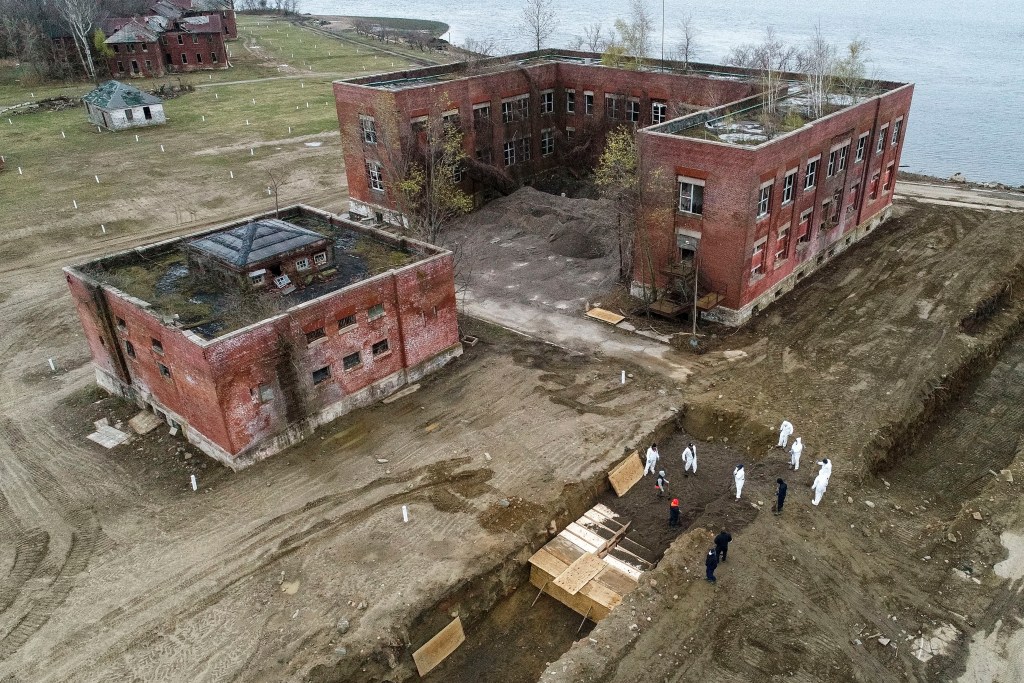
Burials in Hart Island are carried out in mass graves, where the dead are laid to rest in trenches dug into the earth. The island’s burial practices include stacking coffins in rows.
The dead are buried in trenches. Babies are placed in coffins, which are stacked in groups of 100, measuring five coffins deep in rows of twenty.
Adults are placed in larger pine boxes placed according to size, and are stacked in sections of 150, measuring three coffins deep in two rows and laid out in a grid system. Each box is labeled with an identification number, the person’s age, ethnicity, and the place where the body was found, if applicable.

After coffins are assigned a specific plot they are marked with GPS coordinates for fast and efficient retrieval if necessary. The potter’s field is also used as a disposal site for amputated body parts, which are placed in boxes labeled “limbs”.
Before civilian contractors began doing the actual burials in 2020, inmates from the nearby Rikers Island jail were paid fifty cents an hour to bury bodies on Hart Island.

The bodies of adults are frequently disinterred when families are able to locate their relatives through DNA, photographs and fingerprints kept on file at the Office of Chief Medical Examiner of the City of New York. There were an average of 72 disinterments per year from 2007 to 2009.
As a result, the adults’ coffins are staggered to expedite removal. Children, mostly infants, are rarely disinterred. Regulations stipulate that the coffins generally must remain untouched for 25 years, except in cases of disinterment.
Approximately half of the burials are of children under five who are identified and died in New York City’s hospitals, where the mothers signed papers authorizing a “City Burial.” Sadly, most of these mothers were generally unaware of what the phrase meant.
Ceremonies have not been conducted at the burial site since the 1950s. In the past, burial trenches were re-used after 25–50 years, allowing for sufficient decomposition of the remains. Since then, however, historic buildings have been demolished to make room for new burials.
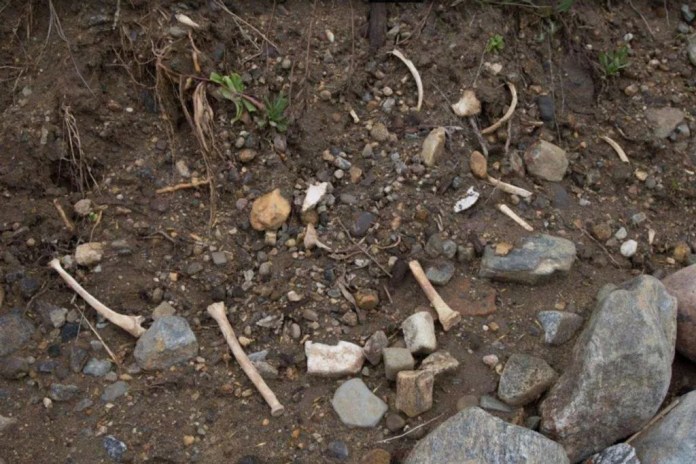
Those interred on Hart Island are not necessarily homeless or indigent. Many of the dead either had families who could not afford the expenses of private funerals or were not claimed by relatives within a month of their death.
Notable burials include the playwright, film screenwriter, and director Leo Birinski who was buried there in 1951 after dying alone and in poverty. American novelist Dawn Powell was buried on Hart Island in 1970, five years after her death, after her remains had been used for medical studies and the executor of her estate refused to reclaim them.
Academy Award winning child actor Bobby Driscoll, famous for his portrayal of Peter Pan in the Walt Disney film of the same name, who was found dead in 1968 in an abandoned East Village apartment building, was buried on Hart Island because his remains could not be identified in a timely fashion. T-Bone Slim, labor activist and songwriter, was also buried on Hart Island after his body was found floating in the Hudson River in 1942.
In 1985, sixteen bodies of people who died from AIDS were buried in deep graves on a remote section of the southern tip of the island because at the time it was feared that their remains would be contagious.
An unnamed infant victim of AIDS is buried in the only single grave on Hart Island with a concrete marker that reads SC (special case) B1 (Baby 1) 1985. Since then, thousands of people who have died of AIDS have been buried on Hart Island, but the precise number is unknown.
During the 1980s AIDS epidemic those who had died from AIDS were the only people to be buried in separate graves.
At first, bodies were delivered in body bags and buried by inmate workers wearing protective jumpsuits. When it was later discovered that the corpses could not spread HIV, the city started burying people who had died of AIDS in the mass graves.
According to a 2006 New York Times article, there had been 1,419 burials at the potter’s field during the previous year: of these, 826 were adults, 546 were infants and stillborn babies, and 47 were dismembered body parts
In 2008, the island was selected as a site for mass burials during a particularly extreme flu pandemic, available for up to 20,000 bodies.

During the COVID-19 pandemic in New York City, Hart Island was designated as the temporary burial site for people who had died from Covid 19. At the time, deaths at home within the city had increased significantly, though corpses were not tested for COVID-19.
Preparations for mass graves began at the end of March 2020, private contractors were hired to replace inmate labor for mass grave burials. In 2021, an analysis was published that found there was a sharp increase in the number of interments between 2019, when 846 corpses were buried on the island, and 2020, when 2,334 corpses were buried.
In recent years, there has been renewed interest in Hart Island, driven in part by the spike in COVID-19 deaths that necessitated the use of its grounds for mass burials.

As society continues to grapple with the realities of public health, economic disparity, and mortality, Hart Island stands as a poignant reminder of the countless lives that have shaped New York City, often without recognition or memorialization.
As proposals and discussions around the future of Hart Island unfold, its past leaves a tragic and powerful impression. The island not only reflects the historical treatment of its marginalized populations but also embodies broader themes regarding society’s outcasts, the unwanted and societal responsibility in providing final resting places for its most vulnerable citizens.
Ultimately, Hart Island is a testament to the complexity of urban life, where the echoes of history intertwine with the realities of modern existence, reminding us that every life story deserves acknowledgment, no matter how quiet or overlooked. Without judgment. Without judgment.